Bundle three or more performances and save 30%!
Save a whopping 30% on tickets when you bundle at least three Fall and Next Wave programs. To qualify, you must purchase the same number of tickets for three or more programs. Lock in the very lowest prices when you purchase early. Prices are subject to change after July 31, 2026.
Next Wave 2026
Part of Fall 2026
Next Wave 2026 brings bold productions from artists who have presented work at BAM for decades, alongside thrilling creations by artists whose work comes to our stages for the first time. Working in dance, music, poetry, theater, film, movement, memoir, puppetry, and opera, they all create original, individual, and uncompromising art. What they share in common is an emphasis on time: how history is made, how legacy is formed, and how the past informs and shapes the present and future.
We are thrilled to welcome back playwright and director Tiago Rodrigues, a BAM favorite for provocative works like By Heart and Catarina and the Beauty of Killing Fascists, returning with La Distance, a poignant drama introduced at the 2025 Avignon Festival. Einstein on the Beach—50th Anniversary Concert commemorates the revolutionary 1976 opera by Philip Glass and Robert Wilson, whose historic collaboration began with a chance meeting at BAM. And you won’t want to miss Minor Music at the End of the World, an extraordinary multidisciplinary collaboration fusing multiple modes of live performance and film.
This year’s Next Wave also lays groundwork for a BAM milestone yet to come: the 50th anniversary of DanceAfrica, the nation’s largest celebration of African diasporic dance and music, arriving in May 2027. By providing a platform where African artists like Dorothée Munyaneza and Dorcy Rugamba, both from Rwanda, as well as New Yorkers Nehprii Amenii and Okwui Okpokwasili can create work that deals with historical legacy and Afro-futurist possibility, we honor the vital legacy that choreographer and DanceAfrica founder Chuck Davis bequeathed to BAM.
Thank you to our Fall and Next Wave 2026 season supporters.
Next Wave 2026 brings bold productions from artists who have presented work at BAM for decades, alongside thrilling creations by artists whose work comes to our stages for the first time. Working in dance, music, poetry, theater, film, movement, memoir, puppetry, and opera, they all create original, individual, and uncompromising art. What they share in common is an emphasis on time: how history is made, how legacy is formed, and how the past informs and shapes the present and future.
We are thrilled to welcome back playwright and director Tiago Rodrigues, a BAM favorite for provocative works like By Heart and Catarina and the Beauty of Killing Fascists, returning with La Distance, a poignant drama introduced at the 2025 Avignon Festival. Einstein on the Beach—50th Anniversary Concert commemorates the revolutionary 1976 opera by Philip Glass and Robert Wilson, whose historic collaboration began with a chance meeting at BAM. And you won’t want to miss Minor Music at the End of the World, an extraordinary multidisciplinary collaboration fusing multiple modes of live performance and film.
This year’s Next Wave also lays groundwork for a BAM milestone yet to come: the 50th anniversary of DanceAfrica, the nation’s largest celebration of African diasporic dance and music, arriving in May 2027. By providing a platform where African artists like Dorothée Munyaneza and Dorcy Rugamba, both from Rwanda, as well as New Yorkers Nehprii Amenii and Okwui Okpokwasili can create work that deals with historical legacy and Afro-futurist possibility, we honor the vital legacy that choreographer and DanceAfrica founder Chuck Davis bequeathed to BAM.
Thank you to our Fall and Next Wave 2026 season supporters.
ON SALE DATES
Thu, Jun 11 at 1pm
BAM Members and Patrons
Tue, Jun 30 at 1pm
General Public
BAM Members and Patrons get first access and save 20% on single tickets.
All ticket buyers (including BAM Members and Patrons) can create a BAM Bundle (three or more performances) to get 30% off their package.
Join Now
SAVE 30% WITH A BAM BUNDLE
View the Fall and Next Wave 2026 Brochure
Thu, Jun 11 at 1pm
BAM Members and Patrons
Tue, Jun 30 at 1pm
General Public
BAM Members and Patrons get first access and save 20% on single tickets.
All ticket buyers (including BAM Members and Patrons) can create a BAM Bundle (three or more performances) to get 30% off their package.
Join Now
SAVE 30% WITH A BAM BUNDLE
View the Fall and Next Wave 2026 Brochure

EXPLORE THE SEASON
-
 Theater | Music
Hewa Rwanda–Letter to the absent
Oct 7—11, 2026
Hewa Rwanda–Letter to the absent
Oct 7—11, 2026Next WaveIn this self-described “hymn to life,” Rugamba—alongside guitarist Majnun—theatrically adapts his memoir dedicated to his family killed in the Rwandan genocide. -
 Theater
PRELUDE
Oct 13—15, 2026
PRELUDE
Oct 13—15, 2026FREEEn Garde Arts reunites Anne Bogart and Charles L. Mee for a large-scale, free outdoor performance on the plaza, inviting audiences to witness fleeting encounters and moments of connection in New York City. -
 Dance
DanceToi, moi, Tituba…
Oct 23 & 24, 2026
Toi, moi, Tituba…
Oct 23 & 24, 2026Next WaveMunyaneza uses her own body as a danced archive, making suppressed voices audible, visible, and tangible again in this solo performance. -
 Music | Opera
How does it feel to look at nothing
Oct 21—25, 2026
How does it feel to look at nothing
Oct 21—25, 2026Next WaveVisionary composer-performers Holland Andrews and yuniya edi kwon make their BAM debuts with an electrifying interdisciplinary work that fuses sound, movement, and ritual to ponder the ineffable. -
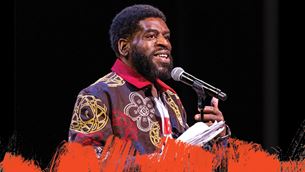 Poetry
I Guess It Was My Destiny To Live So Long
Oct 23—30, 2026
I Guess It Was My Destiny To Live So Long
Oct 23—30, 2026Next WaveHanif Abdurraqib returns with his vital, viral series celebrating poetry as a force for bringing people together, spotlighting powerful voices from across Africa this year alongside friends and neighbors. -
 Music
MusicMeshell Ndegeocello, Samora Pinderhughes
Fri, Oct 23, 2026
Meshell Ndegeocello, Samora Pinderhughes
Fri, Oct 23, 2026Performing under the banner of Hanif Abdurraqib’s transdisciplinary poetry series, versatile composers and instrumentalists Meshell Ndegeocello and Samora Pinderhughes share a night of words and music. -
 Poetry
Poetry Overnight at BAM
Sun, Oct 25, 2026
Poetry Overnight at BAM
Sun, Oct 25, 2026 -
 Music | Poetry
Southern Oracles
Wed, Oct 28, 2026
Southern Oracles
Wed, Oct 28, 2026FREEThe Black Air Poets fuse jazz, hip hop, poetry, dance, and more in a multidisciplinary concert that zooms in on the touchstones and mythology of all things conceptually south. -
 Poetry | Music
Be Holding
Thu, Oct 29, 2026
Be Holding
Thu, Oct 29, 2026Based on Ross Gay poem that links an impossible move by NBA icon Dr. J to Black flight and joy, Be Holding accompanies an evening-length reading with music by Tyshawn Sorey and video accompaniment. -
 Poetry
Stones in the Water
Fri, Oct 30, 2026
Stones in the Water
Fri, Oct 30, 2026Propelled by their deep and abiding friendship, Sarah Kay, Clint Smith, Anis Mojgani, and Hanif Abdurraqib return for their tenth joint engagement celebrating the power of poetry and community. -
 Dance
DanceTurn. Turning. TURNT.
Nov 4—7, 2026
Turn. Turning. TURNT.
Nov 4—7, 2026Next WaveComprising work made prior to, during, and following the 2020 pandemic, Cynthia Oliver’s three-part performance employs an amalgam of sound, design, and light in response to moments in our shared history. -
 Dance | Theater
adaku, part 2
Nov 11—15, 2026
adaku, part 2
Nov 11—15, 2026Next WaveIn a future not so far away, a young woman taught that she has no past has a spiritual awakening, rendered by Okwui Okpokwasili and Peter Born in hypnotic swells of sound, song, and movement through space. -
 Theater
La Distance
Nov 18—29, 2026
La Distance
Nov 18—29, 2026Next WaveAs humanity struggles on earth, a daughter chooses exile on Mars, leaving her father to grapple with the challenge of maintaining connections across unnavigable distances in a timely drama by Tiago Rodrigues. -
 Music
MusicEinstein on the Beach–50th Anniversary Concert
Nov 19—21, 2026
Einstein on the Beach–50th Anniversary Concert
Nov 19—21, 2026Next WaveEinstein on the Beach, the milestone opera by Philip Glass and Robert Wilson, returns to BAM in a 50th-anniversary concert by the Philip Glass Ensemble with a special artistic installation by Es Devlin. -
 Theater | Puppetry
“HUMAN”
Dec 2—5, 2026
“HUMAN”
Dec 2—5, 2026Next WaveThis kaleidoscopic, puppetry-driven performance takes audiences to the bottom of the ocean, exploring what it means to be human in a world where humans no longer exist. -
 Theater
Minor Music at the End of the World
Dec 4—6, 2026
Minor Music at the End of the World
Dec 4—6, 2026Next WaveInspired by two Saidiya Hartman essays and a W.E.B. Du Bois short story, this multi-disciplinary performance in three movements explores the possibility of Black life at the end of the world.